
Soft annealing treatment of cast iron

Soft annealing treatment of cast iron
Gray cast iron and spheroidal graphite cast iron softening annealing, in fact, is a kind of heat treatment for carbide decomposition, for non-alloyed
Abstract
- title: cast iron soft annealing treatment
- Promulgator: ChengChi
- Send date:2024-10-28 11:12:24
- Tags: cast iron,
Keywords: cast iron, castings, annealing, soft annealing, heat treatment, gray cast iron, graphite cast iron, decarburization, softening, carbide, annealing heat treatment,
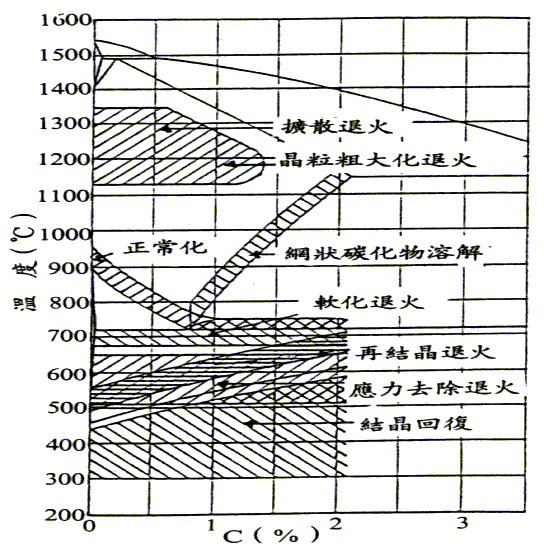 Soft annealing of cast iron
Gray cast iron and spheroidal graphite cast iron softening annealing, in fact, is a kind of heat treatment for carbide decomposition, for non-alloyed and low-alloyed cast iron, iron and carbon formed by carbide is not a stable phase, in high temperature after a period of time long enough, the carbide decomposition into graphite, fat iron or Wolstian iron, this kind of decomposition process is the general so-called softening heat treatment, and at the same time is the manufacturing of ductile cast iron The carbide in gray cast iron is mainly divided into two categories, the first is eutectic carbide (Eutectic Carbide) formed in the solidification process, generally called free carbide (Free Carbide). Softening treatment is mainly divided into two steps, and the first graphitization and the second graphitization, the decomposition of eutectic carbide for the first graphitization, the decomposition of Polaroid iron into fat iron and graphite for the second graphitization. Figure 2-2 shows the time-temperature curve of softening treatment. If the decomposition of Borealis iron is cooled very slowly, the effect of relaxation annealing can be achieved at the same time.
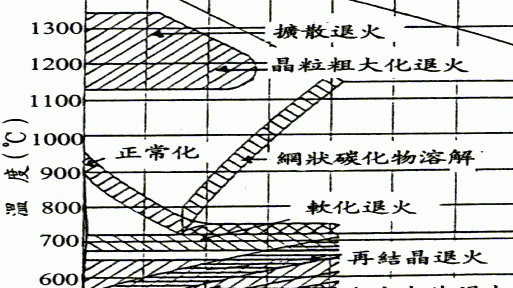
The purpose of the first graphitization treatment in the elimination of eutectic cermet, so when gray cast iron or ductile graphite cast iron, and then solidification process, graphite formation is incomplete, most of the formation of eutectic cermet will be cermet, in the casting corners and sharp edges, due to the cooling rate is faster, or casting metal molds when the effect of the cooling will produce eutectic cermet, the other when the content of silicon is not enough, or inoculated with poor treatment will produce Hard point, or the formation of carbide, if the cast iron with carbide stabilizing elements, Confucian Cr, V or too high a content of manganese, will also form the same result, if it is due to the composition of the combination of inappropriate, the formation of eutectic carbide grain boundaries, the casting of the meat of the original on the formation of carbide will not have an impact on the formation of this kind of carbide in a certain range of temperatures are quite unstable, and the rate of decomposition with the lowering of temperature and the rapid decrease in temperature, and the formation of carbide will not be affected by the casting. Its decomposition rate decreases rapidly with the decrease of temperature and increases rapidly with the increase of temperature. The first graphitization temperature should not be too low, the temperature range of about 850 ℃ to 950 ℃, for spheroidal graphite cast iron, due to the need for high toughness, so the temperature should not exceed 920 ℃, so as to avoid the occurrence of the Wolstadtian iron primary crystals, the annealing time must be increased, annealing time is not only determined by the annealing temperature, and at the same time, need to take into account the type of composition of the cast iron, and even to consider the type of carbide. Generally speaking, the annealing time can be from 2 to 15 hours, in order to avoid decarburization, while considering the economic benefits, the annealing time should be shortened as much as possible, graphitization elements such as silicon and traces of copper can accelerate the decomposition of the XueMing Carbon Iron, and carbide stabilizing elements, such as chromium, aluminum, copper, in the normal circumstances will seriously delay the time of graphitization.
The purpose of the second graphitization process is to eliminate or reduce the amount of pearlite, the main function of which is to decompose pearlite, or after the first graphitization process, during the cooling process, to prevent the re-formation of pearlite, the second graphitization process can be seen in Figure 2-1, should be carried out in conjunction with the first graphitization, or if there is no eutectic carbide present, can be carried out independently. The main implementation steps, is below the metamorphic temperature very slow cooling, or in the metamorphic temperature below the maintenance of a period of time, for spheroidal graphite cast iron, fat particles of iron after the organization of the properties have a very great influence, for gray cast iron, fat particles of iron system organization only make the material soften only, the rate of decomposition of cermet carbon and iron with the increase in temperature increases, the phenomenon is similar to the results of the first paragraph of the graphitization process. Temperature exceeds the range of metamorphic temperature, part of the organization of the Wolstian iron, cooling, can be followed by the formation of Polaroid iron, when the temperature exceeds 600 ℃, Polaroid iron decomposition is very rapid. Until its complete decomposition, annealing time of 8 to 12 hours, when the temperature exceeds a critical point, the growth rate of this fat grain iron will get the opposite effect, it can be seen to fully into the fat grain ironization required annealing time between 4 to 24 hours, the temperature is between 680 to 740 ℃.
More Soft annealing treatment of cast iron: en.chengchi.net/view-239.html
